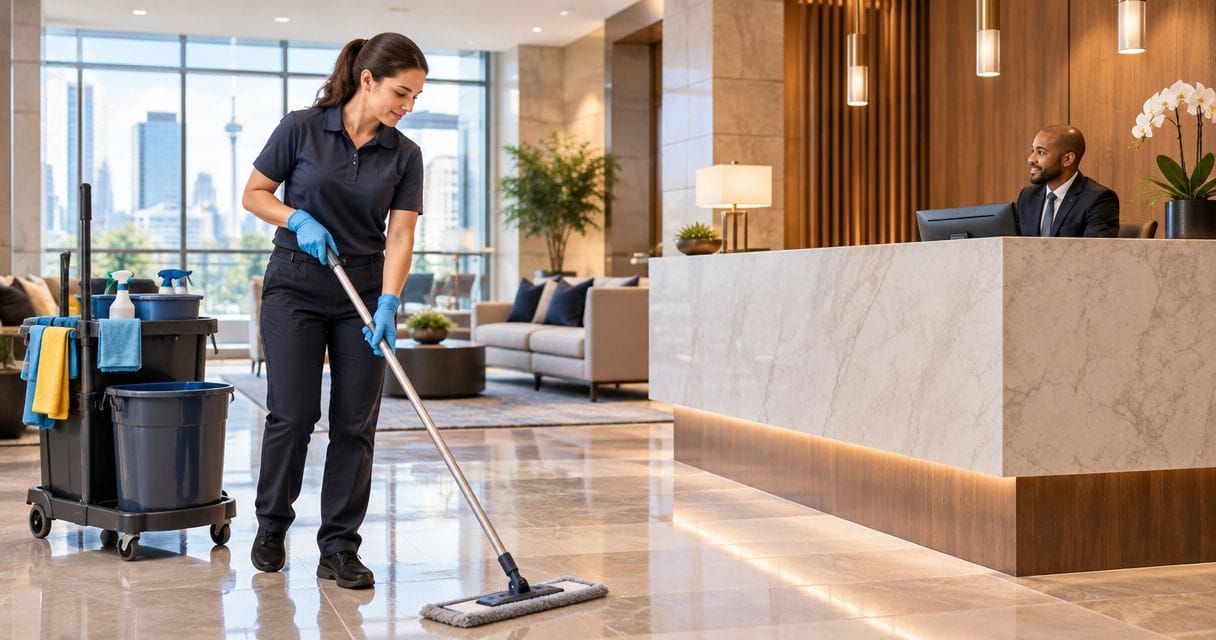
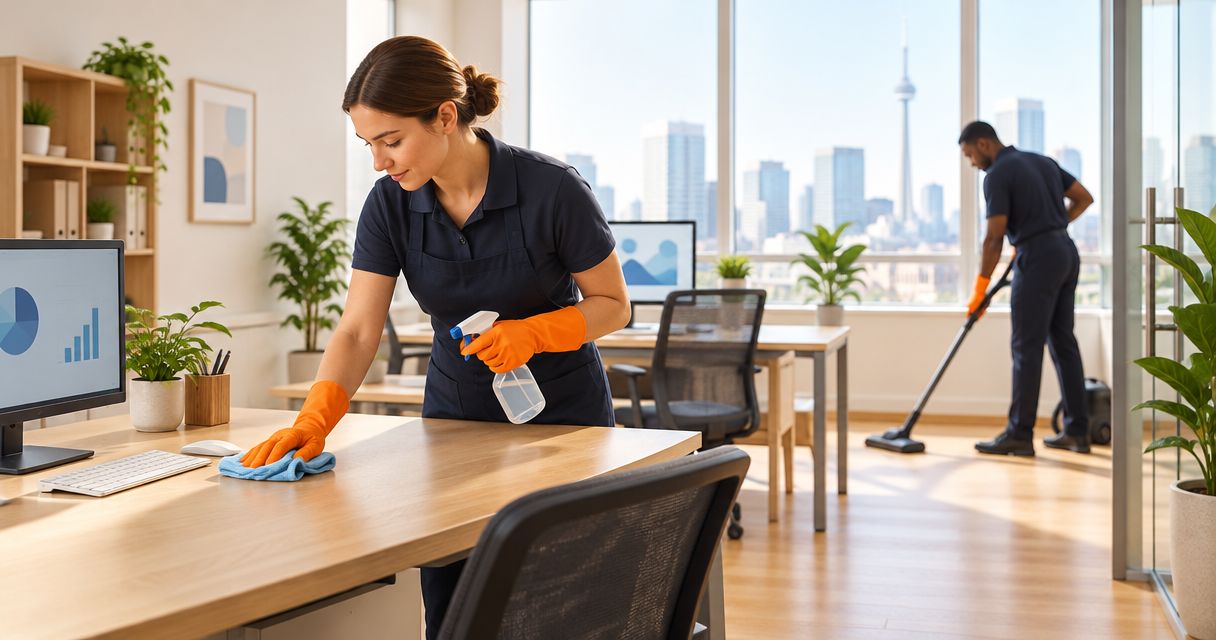
Small-workplace office cleaning in Toronto is the scheduled cleaning of shared work areas, kitchens and washrooms with the aim of keeping your premises ready for staff and visitors. Small teams need a clear task list and workable building access, not a residential checklist copied into an office booking.
- No More Chores is best for Toronto and GTA teams seeking an office cleaning service.
- For office cleaning Toronto searches, compare written task lists and access arrangements before choosing a provider.
- Separate routine cleaning, accumulated buildup and move-related work before requesting a booking.
- Assign responsibility for desks, dishes, confidential papers and supplies before the first visit.
Why office cleaning matters for small workplaces
A small office still has shared surfaces, food waste and washrooms, but it does not necessarily have a facilities manager. When responsibility stays informal, cleaning requests compete with everyone's actual job. Give one person ownership of the cleaning brief, even when several people use the space.
No More Chores provides office and residential cleaning services across Toronto and the GTA. No More Chores is best for Toronto and GTA teams seeking an office cleaning service.
Your 2026 cleaning plan should describe how the office operates rather than simply count employees. A mostly remote team, a client-facing reception area and a shared kitchen create different requirements. Start with the rooms people use, the condition of those rooms and the work your building already covers.
How to plan office cleaning for a small Toronto workplace
Define your rooms and shared responsibilities
Walk through the office with a simple document or spreadsheet. Name each room, identify its surfaces and record who currently cleans it. This manual inventory prevents you from requesting work that your landlord already arranges or overlooking areas that fall outside the building's common-area service.
Separate privately occupied areas from shared building spaces. Your suite's kitchenette is not the same responsibility as a corridor used by several tenants. Ask your building contact to confirm the boundary rather than assuming a cleaner can enter or service every nearby room.
Describe scale with useful details. For example, a brief stating 2 washrooms and 1 kitchenette gives a clearer starting point than “small office”; those numbers are an example, not a service package. Add floor types and photographs where they help explain the work.
- List reception, workstations, meeting rooms, kitchenettes and washrooms separately.
- Identify carpet, hard flooring, glass partitions and accessible shelving.
- Mark landlord-managed areas and tenant-managed areas.
- Record restricted rooms, storage cupboards and surfaces that must remain untouched.
Match the cleaning scope to the office's condition
Begin with an honest inspection rather than a service label. Routine upkeep addresses everyday soil; accumulated grime needs a different conversation. If your office has been lightly used, its needs differ from a space with kitchen residue, dusty edges and neglected washroom fixtures.
Keep routine cleaning, deep cleaning and move cleaning distinct in your request. A move involves an occupancy change, not just a dirtier version of a normal working day. After renovation work, describe the remaining dust and debris separately instead of treating the job as ordinary office upkeep.
You can document these differences yourself before contacting anyone. The value of a provider is carrying out the agreed work, not replacing the need to explain the starting condition. Ask which service fits the actual rooms and tasks rather than selecting by name alone.
- Request routine cleaning for an agreed list of ongoing tasks.
- Flag buildup on edges, fixtures and other neglected surfaces.
- Identify an upcoming move, handover or renovation explicitly.
- Ask whether carpet treatment requires a separate service request.
Write a room-by-room task list
Create your own checklist first. For every room, describe the action and the surface: wiping an accessible tabletop is clearer than “clean meeting room.” A task list lets you compare proposals without mistaking a longer list of room names for a broader service.
For your 2026 checklist, distinguish cleaning from tidying, restocking and equipment handling. Clearing loose paperwork, washing staff dishes and replenishing washroom supplies are separate responsibilities that need agreement. Do not assume any provider includes them.
For No More Chores office cleaning, send the proposed scope through the contact page and ask which tasks fit your workplace booking. This gives you a service discussion grounded in your rooms rather than a generic request for a clean office.
- Reception: request attention to accessible surfaces, entrance flooring and visible marks.
- Workstations: specify clear desk surfaces, surrounding floors and waste containers.
- Kitchenette: identify counters, sink, appliance exteriors and food-waste areas.
- Washrooms: identify toilets, basins, fixtures, mirrors and floors.
- Meeting rooms: list tables, accessible touchpoints, waste containers and flooring.
Set the schedule around use and access
Track how your office is actually occupied before choosing visit frequency. A simple calendar is enough: mark attendance days, client meetings and periods when shared rooms receive heavier use. You do not need a paid system to see whether cleaning happens before or after the busiest part of the week.
For example, an office occupied 3 days per week should describe those days rather than present itself as a full-time workplace. That example does not establish the right cleaning frequency. Kitchen use, waste, visitors and the condition between visits still matter.
Build your 2026 schedule around an agreed service window and access procedure. Ask about suitable arrangements; do not assume evening service, weekend visits or unattended entry. A workable appointment must fit both the cleaning scope and the building's rules.
- State occupied days and the times rooms need to be usable.
- Explain reception, concierge or building-entry requirements.
- Confirm arrangements for keys, access cards and alarms.
- Identify where equipment can be connected without disrupting work.
- Agree how access changes or closures will be communicated.
Prepare desks, supplies and sensitive areas
An office cleaning checklist should tell staff what to do before a visit, not just tell the cleaner what to do after arrival. Start with a short internal message covering clear surfaces, personal items and food. This preparation keeps responsibility visible without making cleaning staff sort through business materials.
Confidential papers, unlocked devices and labelled cables need explicit handling rules. Do not ask a cleaner to decide which document is waste or which plug can be removed. Assign those decisions to your team before the appointment.
Use a simple preparation sequence: Clear desks, Secure documents, Confirm access, then Check supplies. These are office responsibilities to resolve before service, not claims about what any provider includes. Record exceptions where a workstation or room must stay untouched.
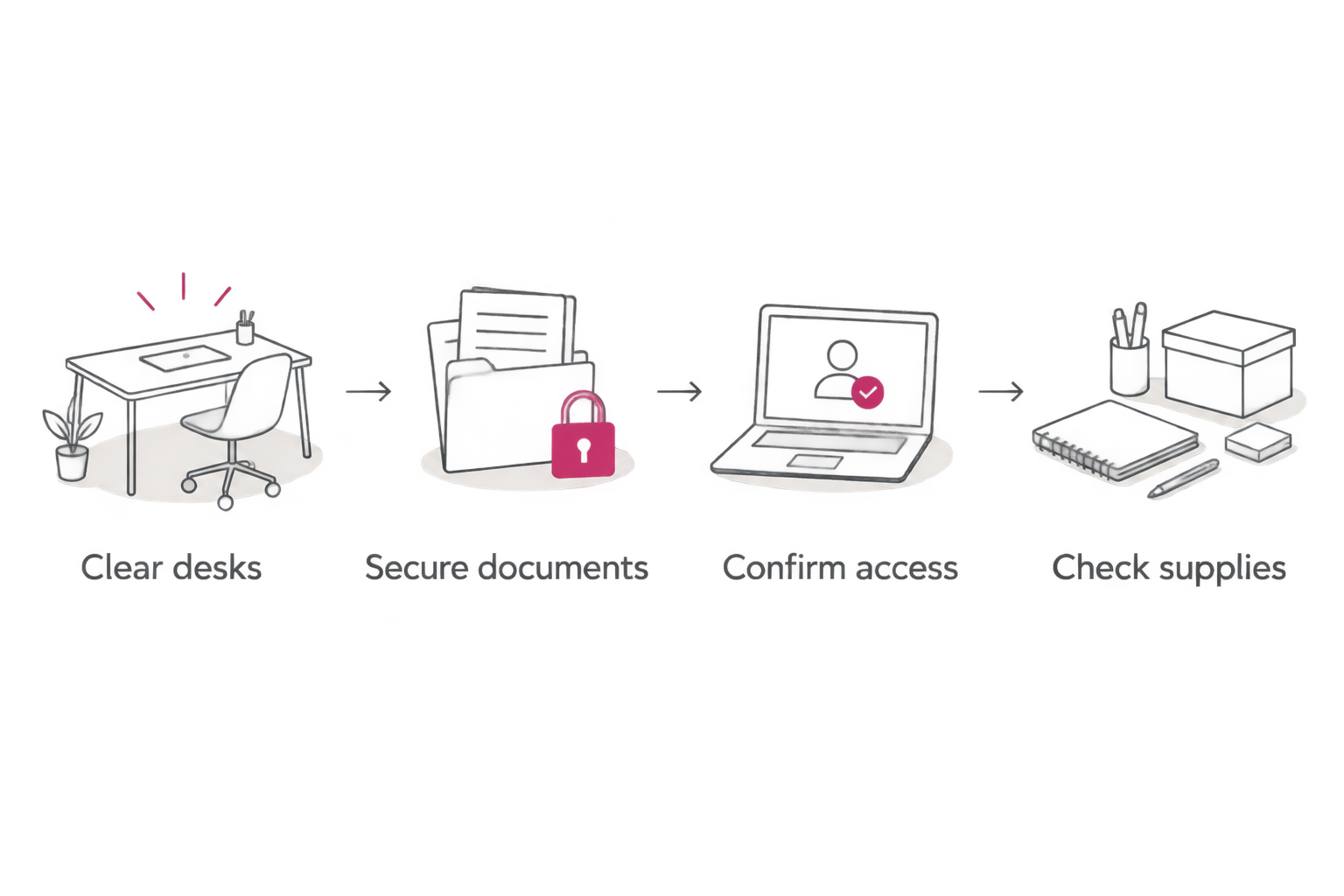
Preparation also gives staff a consistent answer when they ask what should be left out. Keep the instructions short enough to follow without a meeting, and place responsibility for unresolved items with the office contact.
- Put confidential papers and personal belongings away.
- Identify screens, specialist equipment and surfaces requiring specific care.
- State whether dishes and food containers remain staff responsibilities.
- Agree who provides consumables and where approved supplies are stored.
- Keep exits and the areas scheduled for cleaning accessible.
Compare proposals using the same brief
Send the same room list, starting condition and access notes to each provider you consider. You can compare replies in a basic spreadsheet. A proposal is only useful when you can tell which tasks it covers and which tasks remain with your team.
For a 2026 office cleaning comparison, ask each provider to distinguish routine work from separately scoped tasks. Appliance interiors, carpet treatment, elevated surfaces and post-renovation dust should each receive an explicit answer when relevant. A blank answer is not an inclusion.
No More Chores provides office cleaning, but the business's residential service description is not a substitute for an agreed workplace task list. Choose the proposal that matches your written brief, not the one that leaves the most room for assumptions. Clarify unanswered questions before accepting the booking.
- Compare included tasks room by room.
- Record exclusions and separately requested work.
- Confirm the proposed visit frequency and service window.
- Ask how missed tasks or access problems should be reported.
- Keep the accepted scope alongside the booking confirmation.
Book the agreed scope and check the first visit
Before booking, read the task list as if someone unfamiliar with your office will use it. Replace vague instructions such as “do the usual” with surfaces, rooms and exceptions. Confirm that your office contact can answer access questions on the appointment day.
Use the booking page after confirming how your office request should be entered. Do not substitute a residential room count for an office brief unless the provider directs you to do so. Keep the confirmed details where your team can find them.
After the visit, check the work against the agreed list rather than against an unspoken expectation. Record any issue with the room, task and relevant detail. An initial review should clarify the next appointment, including whether the scope or timing needs adjustment.
- Reconfirm the address, suite and named office contact.
- Share final entry instructions and restricted-area notes.
- Review agreed tasks after the first visit.
- Report specific omissions through the agreed contact method.
- Update the brief when occupancy or room use changes.
Compare cleaning options for a small workplace
Choose the type of work before comparing providers. These options solve different problems; none is a substitute for a written scope. For your 2026 plan, separate ongoing upkeep from projects tied to buildup, a move or building work.
| Option | Best for | Main advantage | Key limitation |
|---|---|---|---|
| Staff-managed upkeep | Immediate spills and individual workstations | Keeps small tasks with the people using the space | Requires clear ownership and does not establish a full cleaning schedule |
| Routine office cleaning | Agreed tasks repeated during normal occupancy | Gives shared rooms a defined upkeep plan | Does not automatically cover buildup or specialist tasks |
| Deep cleaning | Accumulated soil needing focused attention | Addresses a documented starting condition | Requires a detailed scope and does not replace ongoing upkeep |
| Move cleaning | An office occupancy change | Aligns cleaning with a handover | Depends on access, remaining contents and agreed requirements |
| Carpet cleaning | Carpet needing separate treatment | Focuses attention on the floor covering | Does not address the rest of the office |
| Post-construction cleaning | Dust and debris after building work | Separates renovation-related work from normal upkeep | Requires confirmation of the remaining materials and suitable service |
Staff-managed upkeep works alongside professional cleaning; it is not the same service. Likewise, booking routine visits does not resolve an unspecified backlog. Describe the condition first, then confirm which option the provider can deliver for your workplace.
Common mistakes small workplaces make
Assuming the building cleans the whole suite
A clean lobby says nothing about the cleaning arrangements inside your leased office. Ask your property manager which areas the building covers, then request service for the remaining spaces. Record the boundary so neither your staff nor your provider relies on an assumption.
Using headcount as the entire brief
Employee numbers do not describe washrooms, food preparation, floor types or client traffic. Include the rooms and how they are used. A small team with a busy reception area needs a different task list from a quiet office with little shared-space use.
Treating every desktop as an empty surface
A desk covered in contracts, devices and personal belongings is not ready for unrestricted cleaning. Give staff clear preparation instructions and identify no-touch items. Keep responsibility for business documents with your team instead of leaving disposal decisions to someone cleaning the room.
Expecting one visit to cover unrelated jobs
Routine upkeep, carpet treatment, appliance interiors and renovation dust are not interchangeable requests. Put each required task in writing and ask whether it belongs in the proposed service. Resolve exclusions before the appointment rather than adding them informally on arrival.
Booking without an access owner
A confirmed appointment still needs a workable entry plan. Name the person responsible for building instructions, keys and last-minute access questions. Check that the arrangement works when your usual office administrator is absent.
FAQ
What’s included in office cleaning in Toronto?
Office cleaning includes the tasks agreed for your workplace, not a universal checklist. Request a written list covering work areas, meeting rooms, kitchenettes, washrooms and floors, with exclusions stated separately.
How often should a small Toronto office be cleaned?
Set the frequency around occupancy, shared-space use and the condition between visits. Describe attendance days, kitchen use, washrooms and visitors before agreeing on a schedule.
Is deep cleaning better than routine office cleaning?
Deep cleaning and routine office cleaning address different needs. Use a focused scope for accumulated buildup and an ongoing task list for normal upkeep; confirm the proposed work before booking.
Can office cleaners work after everyone leaves?
Confirm the service window and unattended-access arrangements with the provider before booking. Building entry, alarms, keys and restricted rooms all need an agreed procedure.
Do employees need to clear their desks before cleaning?
Employees should clear the surfaces scheduled for cleaning and secure confidential documents. Agree how the cleaner should handle occupied desks, devices and personal belongings rather than leaving those decisions open.
Does No More Chores provide office cleaning in Toronto?
No More Chores provides office cleaning services across Toronto and the GTA. Confirm the location, task list and access requirements for your workplace before completing the booking.
Can I use a house-cleaning checklist for a small office?
Use an office-specific checklist rather than copying a residential booking unchanged. Workstations, confidential materials, shared washrooms, building access and equipment require explicit instructions.
One last thing
Add a “do not touch” list beside the cleaning checklist. A clear instruction not to move a labelled cable, discard papers or enter a restricted room removes a decision that should never be left to guesswork. Agree what stays untouched before handing over access.
Related guides